Book-Style Dissertation
Beyond Contact:
How Intergroup Relations with Natives Shape Immigrant Political Integration
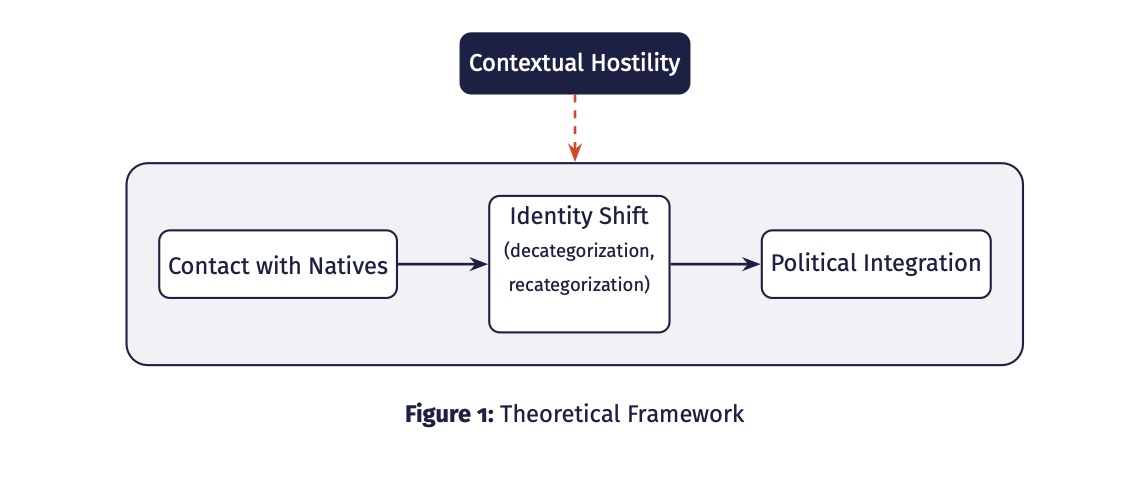
My dissertation develops a minority-centered perspective on intergroup contact, focusing on how immigrants themselves experience and navigate interactions with natives. I argue (1) that contact with natives shapes immigrants’ political integration, but its effect depends on the surrounding climate and (2) that it works by changing how immigrants see themselves. Here, political integration refers to immigrants’ political trust, interest, efficacy, and sense of belonging.
Survey Evidence
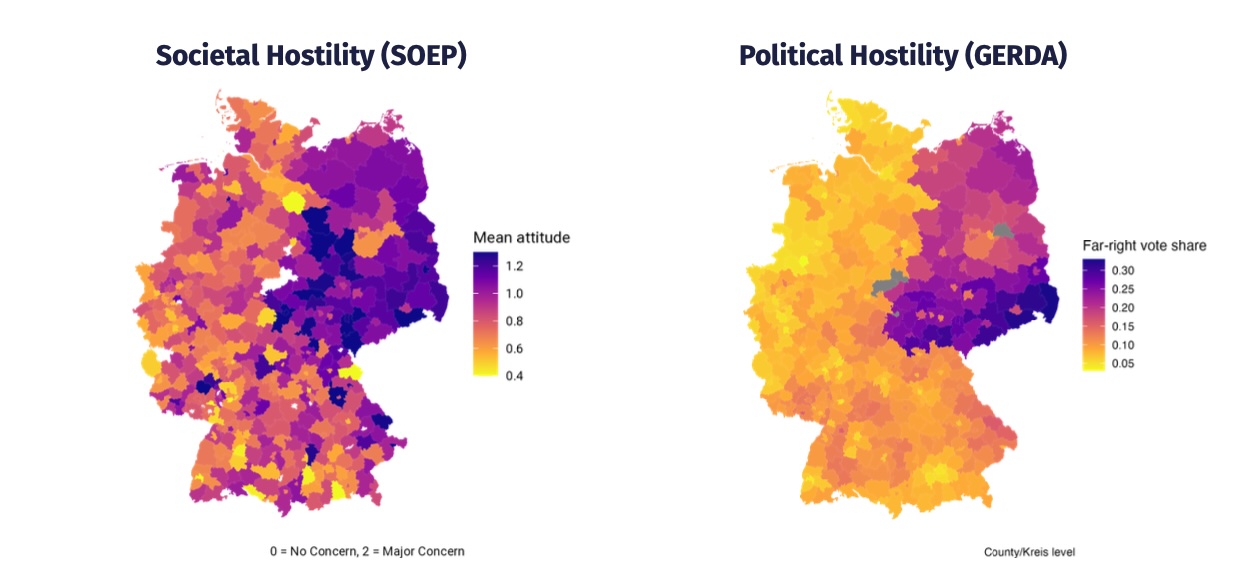
Drawing on the German Socio-Economic Panel (2021–2022), I link immigrants to district-level measures of hostility and use matching to compare otherwise similar individuals exposed to different social contexts. I measure two kinds of hostility separately, because they do not always overlap: societal hostility, meaning everyday anti-immigrant sentiment, and political hostility, measured through far-right support.
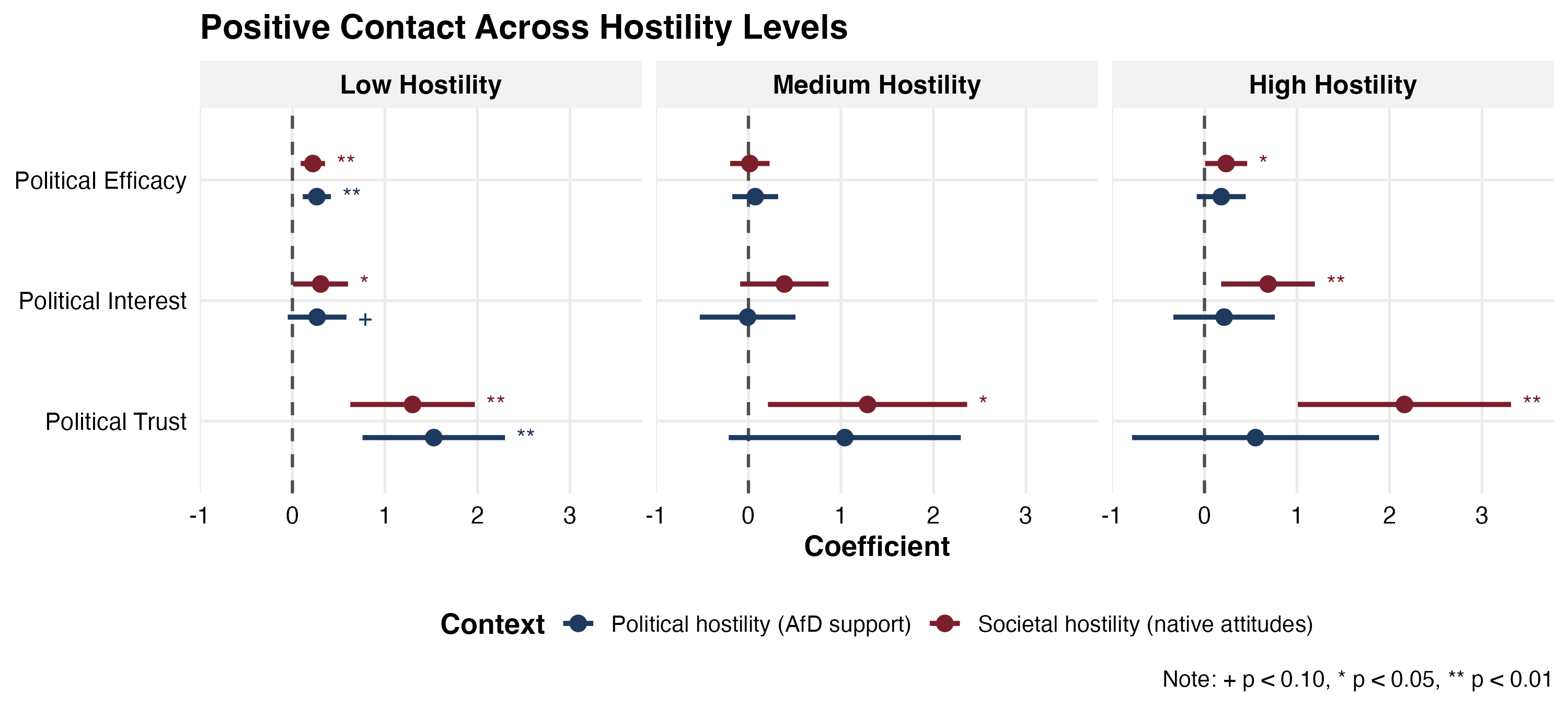
Positive contact with natives is most strongly associated with political integration in more welcoming contexts, whereas hostile environments can limit or alter these relationships.
What Immigrants Say
Selected findings from 35 interviews with first-generation Syrian and Turkish immigrants in Belgium and Germany. Names are pseudonyms.
Positive Contact Is Recognition- or Appreciation-Based Interaction
"My colleagues accepted that I was different, with a different language and culture. I felt respected, and they did not make me feel like I did not know something."
Hala (Syrian woman), Germany
"Mostly we can say positive, but it's quite limited. We are in a safe environment; there's no space to harm each other. But with Belgians, I never go to that deep relationship. Mostly, it's on the surface level."
Sinan (Turkish man), Belgium
Contact Changes How Immigrants See Themselves: Recategorization and Decategorization
"If I feel connected to Germans, then why shouldn't I feel connected to Germany?"
Selin (Turkish woman), Germany
"I saw her as the typical Belgian person. But when we talked, I saw how similar we were in social life and the way we think. That barrier was kind of gone at that point. It made a very big change in my head of how I see the country."
Anas (Syrian man), Belgium
Together, my dissertation shows that contact matters politically when it becomes recognition, and that its consequences depend on the social and political context in which it occurs.